The problem with Terraform at scale
Duplicated code across environments
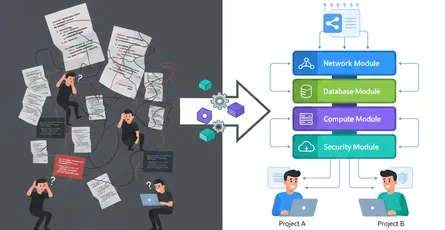
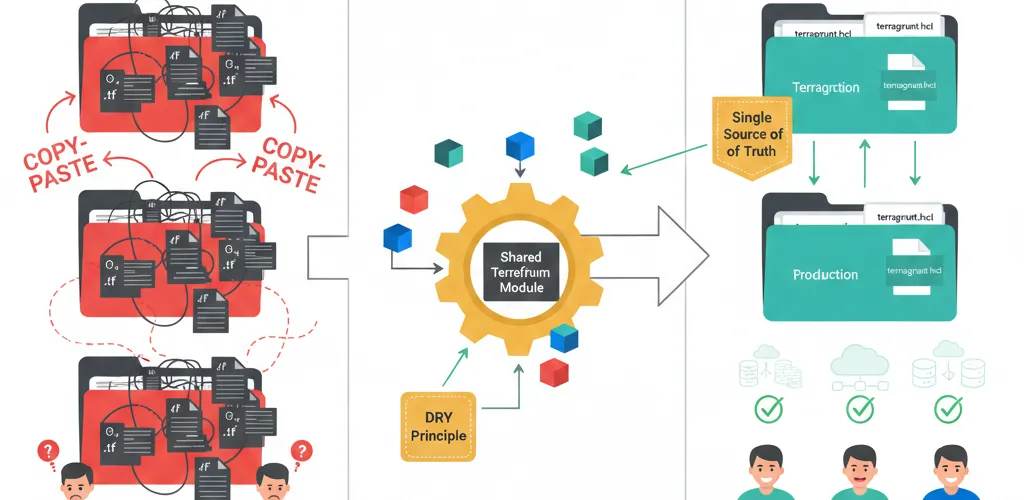
If you’re managing infrastructure with Terraform across several environments or projects, you’ve probably hit the point where every new environment is a copy of the last one. That’s what wrappers like Terragrunt exist for: they keep the shared parts in one file.
Maintenance overhead
With plain Terraform, a change to the backend block is a change in every environment directory. Miss one and that environment quietly runs on the old settings until someone notices the state file in the wrong bucket.
Why Terraform gets messy
Repetitive configuration
Plain Terraform is fine for one environment. Once you’re running dev, staging and production, you’re duplicating backend configuration, provider settings and variable files across directories. Every update means the same edit three times, and the third one is the one you forget.
Environment-specific boilerplate
Each environment needs almost the same configuration with two values changed. That “almost” is where copy-paste errors live, because a diff of two 40-line files is not something you read carefully at 5 PM.
State management
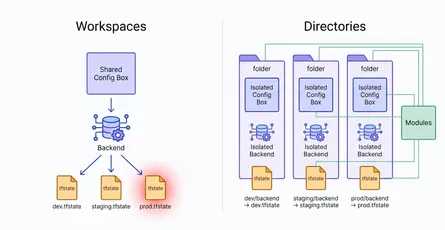
Every environment needs its own state file, its own lock table and its own key prefix. Setting that up by hand for each one is both tedious and the sort of thing that goes wrong silently.
The fix: the Terragrunt wrapper
How Terragrunt works
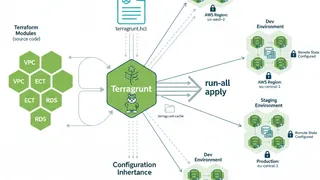
Terragrunt is a thin wrapper around Terraform that fills in the parts Terraform leaves to you. You define your backend config, provider settings and common variables once, and each environment inherits them. Your Terraform modules stay generic, and Terragrunt supplies the environment-specific values.
Configuration inheritance
The root terragrunt.hcl holds the shared settings. Each child config points at it with an include block, so the backend and provider definitions exist in exactly one file.
Environment-specific overrides
A child config adds only what differs: instance sizes, CIDR ranges, replica counts. The module never learns which environment it is running in, which is what makes it safe to reuse.
What it looks like in practice
Instead of duplicating the backend config in every environment, you define it once in the root terragrunt.hcl and let Terragrunt generate the per-environment state key from the directory path.
What Terragrunt gives you
DRY infrastructure code
- Use Terragrunt to remove duplicate code across environments.
- Define backend and provider configs once, reuse everywhere.
- Keep your Terraform modules generic and environment-agnostic.
- Let Terragrunt handle state management and dependencies between modules.
State management you don’t write
Terragrunt derives each state key from the directory structure and creates the backend if it doesn’t exist, so a new environment is a new folder rather than a checklist.
Consistent configuration
Every environment starts from the same base, and the differences are the handful of values you wrote down on purpose.
Why Terragrunt matters for teams
Scaling past a few environments
Terragrunt keeps a Terraform repo readable as it grows. Less time copying files, more time on the infrastructure itself. It does add a tool and a config language to learn, and that cost is real, though it’s paid once rather than per environment.
Productivity
An update lands in one file and applies everywhere, so the “did we update staging too?” conversation stops happening.
Less to hold in your head
There’s less code between a new hire and their first change, and most of what’s left is the part that actually describes your infrastructure.
What’s your Terraform strategy?
Community approaches
Do you use Terragrunt or another wrapper for Terraform? How do you keep your infrastructure code clean across environments?
Alternative tools
Terragrunt, Terraspace and hand-rolled wrapper scripts all solve this, and the shell script is genuinely the right call for some teams. I’d like to know which one you kept.