Why organize your Terraform code?
Where the complexity comes from
If you’re using Terraform to build out your infrastructure, you know how quickly things get complicated. Every new environment, every new account, every new team wants a slightly different version of the same VPC. That’s where modules come in. Think of them as the thing that keeps your code reusable instead of copied.
What structure buys you
A module gives one VPC, one RDS instance or one IAM setup a single definition that every environment calls. When the definition changes, you change it once and bump a version tag instead of hunting through five directories.
The problem with messy Terraform code
Duplicated code
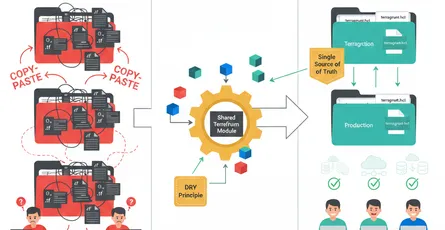
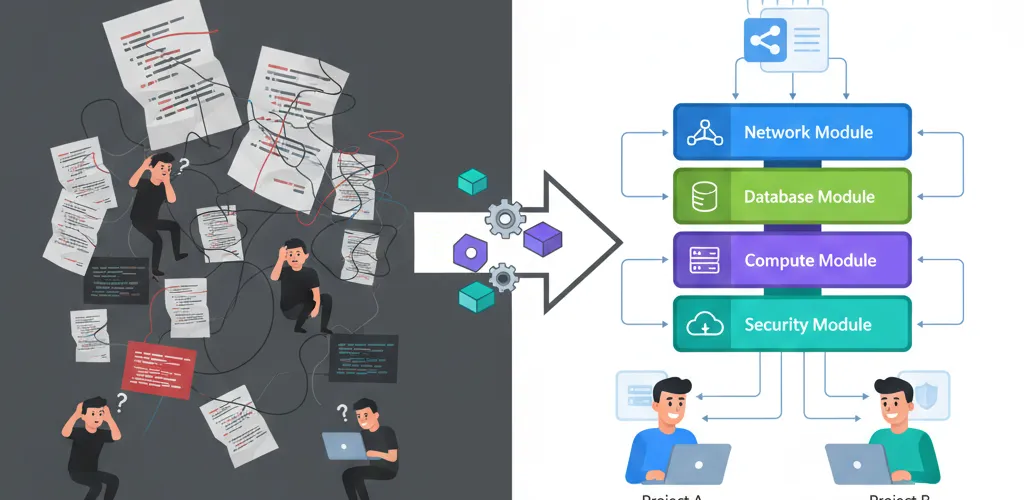
As your infrastructure gets bigger, your Terraform files turn into a real tangle. You copy and paste code, you end up with files nobody wants to open, and you lose track of which copy is current. Updates become a headache, and your whole team slows down with you.
Maintenance pain
Large, monolithic Terraform files are hard to read, hard to test and hard to change. A tweak to a security group in one area can break an unrelated part of your infrastructure, and terraform plan is the first place you find out.
Team collaboration problems
When several people work on the same large files, merge conflicts become frequent, and resolving a conflict in HCL that describes live infrastructure is exactly the kind of merge you don’t want to get wrong.
The fix: Terraform modules
How a module is structured
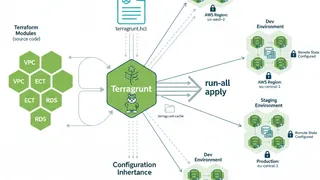
Imagine modules as ready-to-go blueprints for parts of your infrastructure. You could create a module for a standard network setup or a database configuration. Then you reuse that blueprint across different projects or environments. Store these modules in a shared place, like a Git repository, so your team can call them up with a few lines of code whenever needed.
Reusing a module
Once a module exists, every project and environment calls the same source. Each caller passes its own variables, so dev and prod share the definition without sharing the sizing.
Version control and sharing
Pin the module source to a tag rather than a branch. A shared repository means everyone on the team can call the module with a few lines of code, and pinning means a change to main doesn’t reach production until someone chooses it.
Module concepts
Breaking infrastructure into modules
- Split your Terraform code into modules for the pieces you build more than once.
- Put those modules in a shared repository so everyone on the team can reach them.
- Use input variables to customize how a module behaves for different situations.
Input variables
Input variables are the only knobs a caller gets. Expose instance sizes, CIDR ranges and counts. Keep naming conventions and tagging inside the module, so callers can’t drift from them by accident.
Module dependencies
Modules can reference each other’s outputs, and that’s how a network module feeds subnet IDs to a database module. It’s also how you get an ordering problem, so keep the dependency chain shallow enough to explain out loud.
What modules give you
Code quality
Modules stop you writing the same configuration over and over. Fewer copies means fewer mistakes, and it means a review of one module covers every place that module is used.
Faster development
Reusable modules mean less time on boilerplate. Standing up a new environment turns into filling in variables rather than writing HCL from scratch.
Team productivity
Everyone works from the same definitions, so a discussion about the network is a discussion about one module instead of five copies that have quietly diverged.
What’s your approach?
Community insights
How do you like to keep your Terraform projects organized? Any tips or tricks you’ve picked up along the way?
Sharing what works
Whether you’re using the Terraform Registry, Git submodules or a private registry, the trade-offs are different, and hearing how you landed on yours is useful to the rest of us.