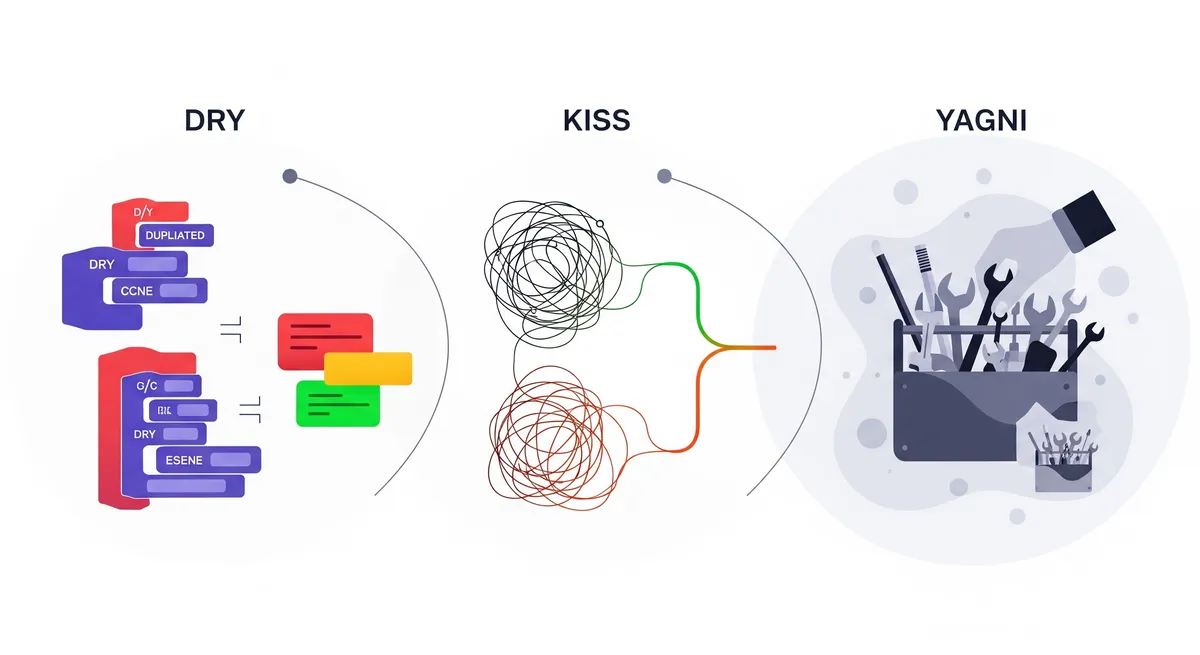
Some software engineering principles hold up no matter what stack you’re using. They guide you toward maintainable, efficient code. Here’s a look at why every developer should know them.
What is the DRY principle, and why is it important?
DRY (Don’t Repeat Yourself) is about writing a piece of logic once and reusing it.
- Avoid code duplication: repeating the same code in multiple places increases the risk of errors and makes maintenance harder.
- Modularize code: break functionality into reusable modules or functions, which cuts duplication and keeps behaviour consistent.
Here’s a common example in Python that doesn’t adhere to the DRY principle:
def create_user_profile(user_id, name, email): profile = { "id": user_id, "name": name, "email": email, "welcome_message": f"Welcome {name}! Your email is {email}." } print(f"Creating profile for {name} with email {email}") return profile
def send_welcome_email(name, email): message = f"Hello {name}, welcome to our platform! Please verify your email: {email}." print(f"Sending email to {email}: {message}")The above code repeats the process of constructing welcome messages. Let’s refactor it to adhere to the DRY principle:
def format_welcome_message(name, email): return f"Hello {name}, welcome to our platform! Please verify your email: {email}."
def create_user_profile(user_id, name, email): profile = { "id": user_id, "name": name, "email": email, "welcome_message": format_welcome_message(name, email) } print(f"Creating profile for {name} with email {email}") return profile
def send_welcome_email(name, email): message = format_welcome_message(name, email) print(f"Sending email to {email}: {message}")By creating a single function to format welcome messages, we eliminate redundancy and improve maintainability.
How does the KISS principle improve software development?
KISS (Keep It Simple, Stupid) advocates for simplicity in design and implementation.
- Clarity and readability: simple code is easier to understand, debug, and maintain.
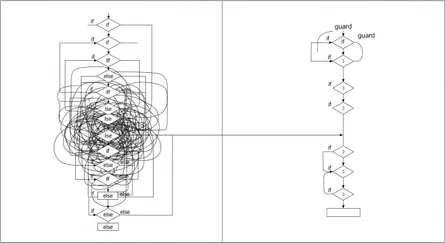
- Reduce complexity: avoid over-engineering by choosing straightforward solutions over unnecessarily complex ones.
Consider the following Python code snippet for logging user activities:
import logging
def log_user_activity(user_id, activity): logging.basicConfig(level=logging.DEBUG, format='%(asctime)s %(message)s') logger = logging.getLogger() log_message = f"User {user_id} performed {activity}." if activity == 'login': logger.debug(log_message) elif activity == 'logout': logger.debug(log_message) elif activity == 'error': logger.error(log_message) else: logger.info(log_message)The above code is more complex than necessary. Let’s simplify it:
import logging
logging.basicConfig(level=logging.DEBUG, format='%(asctime)s %(message)s')logger = logging.getLogger()
def log_user_activity(user_id, activity): log_message = f"User {user_id} performed {activity}." logger.log(logging.DEBUG if activity in ['login', 'logout'] else logging.INFO, log_message)By using a more straightforward approach, we keep the same behaviour and the code is easier to read.
What does YAGNI mean in software development?
YAGNI (You Aren’t Gonna Need It) encourages developers to avoid adding functionality prematurely.
- Focus on requirements: implement only the features that are currently needed, not the speculative ones.
- Avoid over-engineering: when you build only what is needed, there is less complexity and less room for bugs.
Consider the following Python code snippet for handling user permissions:
def get_user_permissions(user_role, has_admin_rights, is_super_user, is_active): if not is_active: return "No permissions" if is_super_user: return "All permissions" if has_admin_rights: return "Admin permissions" if user_role == "editor": return "Edit permissions" if user_role == "viewer": return "View permissions" return "No permissions"This code over-engineers the permissions logic. Let’s simplify it by focusing on essential functionality:
def get_user_permissions(user_role): permissions = { "super_user": "All permissions", "admin": "Admin permissions", "editor": "Edit permissions", "viewer": "View permissions" } return permissions.get(user_role, "No permissions")By adhering to the YAGNI principle, we eliminate unnecessary complexity and focus on core requirements.
Conclusion
Understanding and applying principles like DRY, KISS, and YAGNI makes a real difference in code quality and maintainability. They push you toward code reuse, simplicity, and building only what you actually need.
References
- “Don’t repeat yourself.” Wikipedia, https://en.wikipedia.org/wiki/Don%27t_repeat_yourself
- “KISS principle.” Wikipedia, https://en.wikipedia.org/wiki/KISS_principle
- “You ain’t gonna need it (YAGNI).” Wikipedia, https://en.wikipedia.org/wiki/You_aren%27t_gonna_need_it
- Fowler, Martin. “Yagni.” MartinFowler.com, https://martinfowler.com/bliki/Yagni.html
- “SOLID Principles for C# Developers” - Atree (While C#-focused, SOLID principles are related and often discussed alongside DRY, KISS, YAGNI.), https://www.atree.com.au/insights/solid-principles-for-c-developers/
- “Refactoring Guru: Code Smells.” (Discusses issues often solved by applying these principles.), https://refactoring.guru/smells